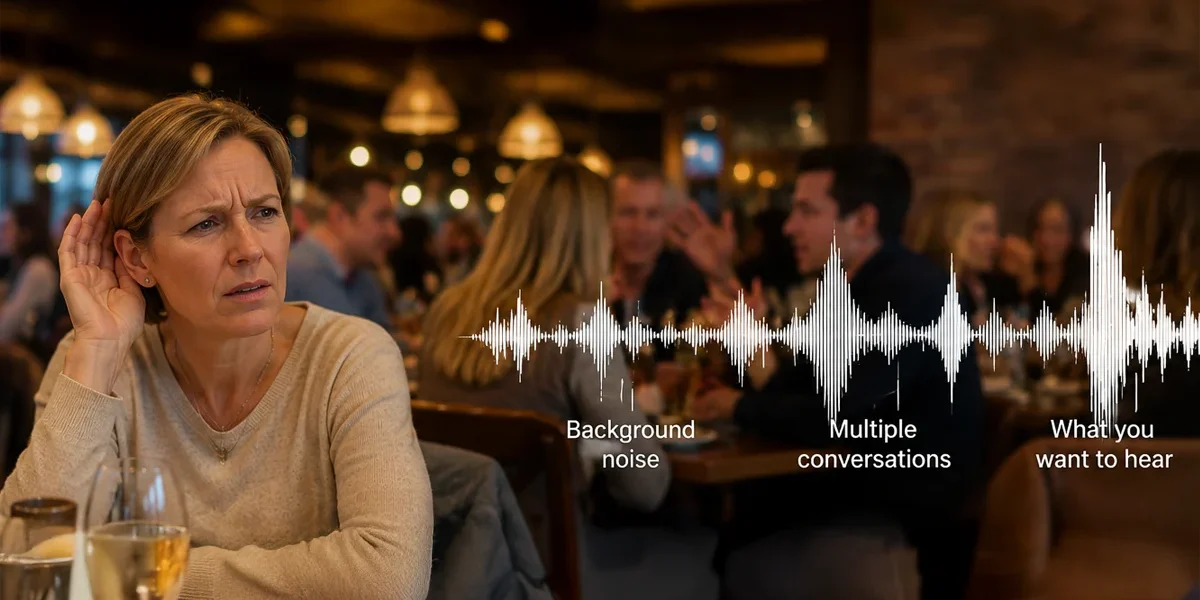
“Why Can’t I Hear in Noisy Restaurants?” What an Edinburgh Audiologist hears in the Consulting Room…
This is the question so many patients ask before they ever book a hearing test. The answer is interesting, and more hopeful, than most people expect.
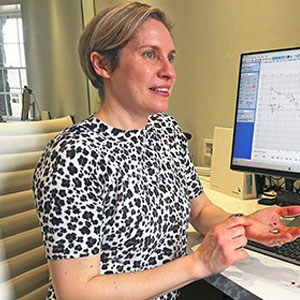
BSc (Hons) Audiology (2012) | HCPC Registered Hearing Aid Dispenser (HAD01925) | Member, British Academy of Audiology (BAA) | Specialist in AI-Powered Hearing Devices, Complex Fitting Presentations, and Speech-in-Noise Rehabilitation
Louise has a BSc (Hons) in Audiology and has worked across both NHS and private practice, building deep expertise in advanced hearing aid technology, AI-powered devices, and the management of complex hearing presentations.
HCPC Registration: HAD 01925 | Page written: July 2026 | Verify HCPC registration: hcpc-uk.org
The Noise Problem: Why the Restaurant Is the Hardest Hearing Challenge and What to Do About It
‘I can hear people talking. I just cannot make out what they are saying.’ That sentence, or a version of it, is how a large proportion of my patients describe their hearing before their first assessment.
The setting is almost always a restaurant, a party, a noisy pub, or a busy workplace. Somewhere with multiple voices, background music, hard surfaces, and little acoustic damping.
This is the most common pattern of complaint in adult audiology. And it is significantly more complicated than ‘my hearing is going.’
Understanding why the noisy restaurant is specifically so difficult and what can actually be done about it changes the conversation in a useful way.
1. Why restaurants are acoustically brutal
2. What ‘hearing in noise’ actually tests in the auditory system
3. Hidden hearing loss: the audiogram that looks normal but is not the full picture
4. How age changes speech-in-noise performance even with normal hearing thresholds
5. What a comprehensive assessment tells you that a standard hearing test does not
6. What can actually be done about speech-in-noise difficulty
7. Practical strategies while you wait, decide, or adjust
8. Frequently asked questions
Why Restaurants Are Acoustically Brutal
A busy restaurant is designed almost entirely against good hearing. Hard floors, hard tables, hard ceilings, bare walls, all high-reflectance surfaces that scatter sound in every direction.
Multiple sources of noise: kitchen clatter, background music, and the accumulated conversation of every other table, each contributing to a broadband noise background that sits directly in the frequency range of speech. And then right in the middle of it all, the conversation you actually want to hear.
There is a phenomenon called the cocktail party effect, which describes the normal auditory system’s remarkable ability to separate a single voice from a complex, noisy background.
It depends on a combination of mechanisms: the slight timing difference between each ear’s reception of the same sound (used for localisation), learned patterns of what speech looks and sounds like at the level of fine spectral detail, and top-down cognitive attention that prioritises certain signals over others.
Every one of these mechanisms is compromised to some degree when hearing loss is present. And the restaurant environment combines all the worst features: high reverberation (which destroys the timing cues used for localisation), continuous broadband noise (which masks the fine spectral detail of speech), and high cognitive demand (which depletes the attentional resources used for top-down separation).
This is not a failure of willpower or attention. It is a specific acoustic challenge that the impaired auditory system is less equipped to meet. Understanding this helps, it replaces frustration with a more productive question: what specifically is happening, and what can be done about it?
What ‘Hearing in Noise’ Actually Tests in the Auditory System
Detecting that a sound is present and understanding what it means are not the same process in the auditory system. Pure tone audiometry, the standard hearing test, which measures the quietest tones you can detect at different frequencies, tests the first.
It tells us whether the cochlear hair cells responsible for detecting each frequency are intact. It does not test the second.
Understanding speech in noise requires something additional: temporal fine structure processing, which is the auditory system’s ability to track the rapid fluctuations in the acoustic signal that distinguish one consonant from another.
It requires central auditory processing, the brain’s ability to interpret the degraded signal arriving from a damaged cochlea. And it requires working memory and cognitive processing speed, both of which affect how efficiently the brain interprets the speech signal in real time.
A person can have a hearing test result that falls within the normal range and still struggle significantly in noise. The audiogram tells you about detection thresholds.
It does not tell you about the suprathreshold processing that determines whether speech in noise is understood.
This is why so many people in their late forties or fifties, who have been told ‘your hearing is normal’, are still struggling in restaurants.
Their hearing thresholds may be normal. Their temporal processing and speech-in-noise performance may not be.
The clinical term: cochlear synaptopathy or ‘hidden hearing loss’
Research in the past decade has identified a form of auditory damage, sometimes called hidden hearing loss, in which the synaptic connections between cochlear hair cells and the auditory nerve are damaged without producing measurable changes in hearing thresholds.
The audiogram looks normal. But speech-in-noise performance is impaired. This is an active area of clinical research and one reason why a comprehensive assessment goes beyond a standard pure tone audiogram.
Hidden Hearing Loss: the Audiogram That Looks Normal but Is Not the Full Picture
The concept of hidden hearing loss, technically, cochlear synaptopathy, emerged from animal research and has since been studied extensively in humans. The working hypothesis is that noise exposure and ageing damage the synaptic connections between the inner hair cells and the auditory nerve fibres before they damage the hair cells themselves. Standard pure tone audiometry measures hair cell function. It is insensitive to synaptopathy.
What this means clinically is that some people, particularly those with significant noise exposure histories who have ‘passed’ standard hearing tests, have genuine speech-in-noise difficulties that a pure tone audiogram cannot explain or quantify. The audiogram is not wrong; it is simply incomplete as a measure of functional hearing.
Speech discrimination testing, measuring how accurately you can repeat back words or sentences presented at varying volumes and signal-to-noise ratios, provides additional information that the pure tone audiogram does not.
A comprehensive audiological assessment at Fairfield Hearing includes speech discrimination testing as a standard component, precisely because it reveals patterns of difficulty that pure tone thresholds alone cannot capture.
How Age Changes Speech-in-Noise Performance Even with Normal Hearing Thresholds
This is a conversation I have often, and it matters. Auditory ageing is not a single process. Several things change with age that affect speech-in-noise performance independently of any measurable change in hearing thresholds:
- Temporal processing speed slows. The auditory system’s ability to track rapid changes in the speech signal, the fine temporal structure that distinguishes consonants, becomes less precise with age. This is partly peripheral (auditory nerve function) and partly central (brainstem and cortical processing speed).
- Working memory capacity declines. Understanding speech in noise is cognitively demanding. It requires holding earlier parts of a sentence in working memory while processing the end of it. As working memory capacity declines with age, this becomes harder, independently of hearing sensitivity.
- The auditory cortex adapts less rapidly. The brain’s ability to use top-down attention to suppress unwanted auditory input becomes less effective with age. Background noise that a younger listener’s auditory cortex suppresses automatically becomes more intrusive.
The practical consequence is that two people with identical audiograms can have meaningfully different speech-in-noise experiences, and that the standard recommendation of ‘come back when your hearing gets worse’ is not always the right advice for someone who is already struggling in noise despite ‘normal’ pure tone thresholds.
What a Comprehensive Assessment Tells You That a Standard Hearing Test Does Not
A comprehensive hearing assessment at Fairfield Hearing goes beyond pure tone audiometry. For patients presenting with speech-in-noise complaints, the assessment includes:
- Speech discrimination testing in quiet. Establishes how accurately you hear speech when noise is not a factor. This reveals whether the difficulty is primarily peripheral (cochlear) or whether there is a suprathreshold component.
- Speech discrimination testing in noise. Where available, this is the most clinically relevant single measure for someone presenting with restaurant-specific difficulty. It directly quantifies the gap between your hearing sensitivity and your speech understanding in conditions that resemble real life.
- Detailed case history including noise exposure and occupational history. The history shapes the clinical picture. Someone with 20 years of noise exposure in a construction environment who passes a pure tone audiogram but struggles in restaurants has a different clinical picture from a retired teacher with the same audiogram result.
- Tympanometry and middle ear assessment. Conductive components, fluid, Eustachian tube dysfunction, can contribute to speech-in-noise difficulty and are easily identified and often treatable.
The clinical picture from these combined measures shapes the recommendation, which may be amplification, amplification with specific speech-in-noise processing features, an environmental and communication strategy programme, or simply monitoring with a clear baseline established for future comparison.
What Can Actually Be Done About Speech-in-Noise Difficulty
The answer depends on the underlying cause. That is the primary reason a comprehensive assessment matters before any management decision is made.
If hearing loss is confirmed: AI hearing aids with directional and noise processing
If the assessment identifies measurable hearing loss, modern AI hearing aids are the most effective available intervention for speech-in-noise difficulty.
The current generation of devices uses deep neural network processing to classify acoustic environments and apply speech-in-noise processing strategies in real time, a genuine clinical advance on the previous generation of rule-based directional processing.
Not all hearing aids perform equally in noise. Phonak’s Audeo Infinio Sphere consistently achieves the highest independent speech-in-noise scores.
Oticon’s Intent prioritises natural spatial sound and brain-supporting processing.
Starkey’s Omega AI provides simultaneous 360-degree classification.
For a patient presenting specifically with speech-in-noise difficulty as their primary complaint, the device selection matters, and it should be matched to the specific audiometric profile and lifestyle.
If hearing thresholds are normal but speech-in-noise difficulty is confirmed: communication strategies and environmental modification
When the assessment shows thresholds within normal limits alongside measurable speech-in-noise difficulty, amplification may not be the right first step.
In this case, a combination of communication strategy training, environmental modification advice, and a scheduled review to monitor for threshold changes provides the most clinically appropriate pathway.
Lip reading and communication skills
The contribution of visual information to speech understanding is substantial, estimates suggest it can improve intelligibility in noise by the equivalent of 10 to 15 dB.
Developing awareness of this resource, and practising the use of visual cues in combination with auditory information, is a clinically useful strategy for anyone struggling in noise, regardless of hearing aid status.
Hearing loop technology and remote microphone systems
For patients already wearing hearing aids, remote microphone accessories, which place a microphone close to the speaker and transmit directly to the hearing aid, are among the most effective hearing aid accessories available for specific noisy environments.
A remote microphone placed near the person you most want to hear at a dinner table effectively eliminates the problem the restaurant environment creates, because the speaker’s voice is being captured before the noise has a chance to mask it.
Practical Strategies While You Wait, Decide, or Adjust
Whether you are waiting for an appointment, considering your options after an assessment, or in the early stages of adjusting to new hearing aids, the following practical strategies will help reduce the difficulty of noisy situations right now:
- Book tables in restaurants at quieter times, early evening rather than peak hours. Ask to be seated away from the kitchen, the bar, and the main thoroughfare.
- Choose restaurants with soft furnishings, carpets, upholstered seating, curtains, acoustic ceiling panels. These absorb reflected sound and reduce reverberation.
- Position yourself with your back to the wall when possible, facing the room. This reduces the noise sources behind you and makes the direction of speech more consistent.
- Make it normal to ask people to face you when they speak. The visual contribution to speech understanding is significant and often underused.
- Reduce the number of competing conversations. A table of four is far easier to follow than a table of ten. Smaller gatherings in quieter settings are not a social retreat, they are a practical hearing strategy.
- Tell people about your difficulty. The social embarrassment of hearing loss often leads people to pretend to understand rather than ask for repetition. The result is exhausting and socially isolating. Naming the difficulty removes most of that burden.
Frequently Asked Questions
Is it normal for hearing in noise to get worse with age even without hearing loss?
Yes. Temporal processing speed, working memory capacity, and the brain’s ability to suppress irrelevant auditory input all change with age independently of measurable hearing thresholds.
Speech-in-noise difficulty in someone who has passed a pure tone audiogram is a clinically recognised presentation, not a sign of anxiety or distraction.
Will a hearing aid fix my restaurant problem?
For most people with measurable hearing loss, a well-fitted AI hearing aid with speech-in-noise processing will significantly improve the restaurant experience.
It will not eliminate the difficulty entirely in all circumstances, the acoustic environment is genuinely challenging.
The gap between a noisy environment with well-fitted aids and without them is, for most patients, substantial.
My audiogram was normal. Does that mean there is nothing wrong with my hearing?
A normal pure tone audiogram means your detection thresholds at standard frequencies are within the normal range.
It does not mean your speech-in-noise processing is unaffected.
A comprehensive assessment that includes speech discrimination testing provides a more complete picture.
If you are significantly struggling in noise despite a normal audiogram, this is worth investigating.
Book a comprehensive hearing assessment in Edinburgh
If you are struggling to hear in noisy environments, the most useful thing you can do is book a comprehensive hearing assessment that goes beyond a basic tone test.
No GP referral needed. Free appointments at our Stafford Street and Wardie Avenue Edinburgh clinics.
Call 0131 378 5800 or visit fairfieldhearing.health/what-we-do/hearing-assessments.

BSc (Hons) Clinical Audiology (University of Manchester, 1989) | HCPC Registered Hearing Aid Dispenser | 35+ years clinical practice in Edinburgh | Former Chair, AIHHP | BAA Member
Clinical accuracy statement: All clinical information, audiological procedures, and treatment recommendations described on this page have been personally reviewed by Stephen Fairfield and verified against current HCPC Standards of Conduct, Performance and Ethics; British Society of Audiology (BSA) recommended procedures for pure tone audiometry and speech testing; and NHS Lothian Audiology Service clinical guidance applicable to adult hearing assessment practice in Edinburgh and the Lothians.
This page covers hearing health, audiological assessment, and the diagnosis and management of hearing loss topics, written and reviewed by a qualified, HCPC-registered audiologist.
HCPC Reg No: HAD 00366 | Date of clinical review: July 2026 | Next review due: February 2027 | Verify registration: hcpc-uk.org
You may also like...
-
 Wednesday, May 15, 2024
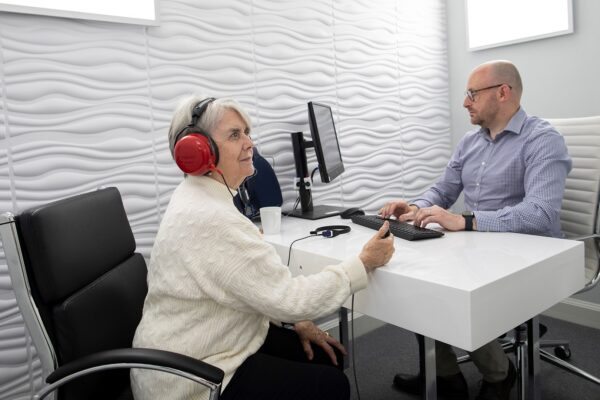
Understanding what to expect during a hearing assessment
In this blog post, we will explore what you can expect during a typical hearing assessment at Fairfield Hearing.
-
 Tuesday, May 28, 2024
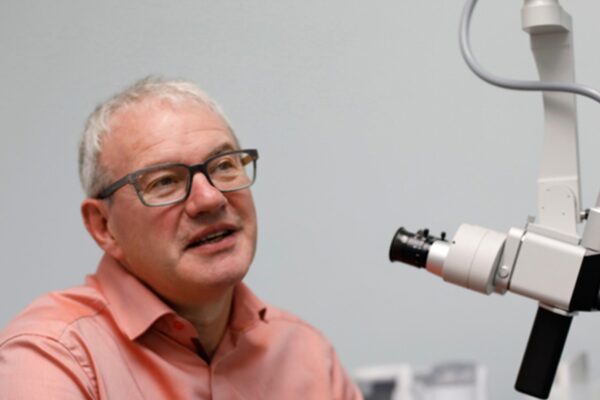
Stephen Fairfield advises on a new system for hearing loss detection
An innovative new screening tool for hearing loss, and how it impacts on people’s lives, has been made possible thanks to investors in Edinburgh and Fairfield Hearing.
-
 Monday, June 1, 2026
Hearing Technology and Time
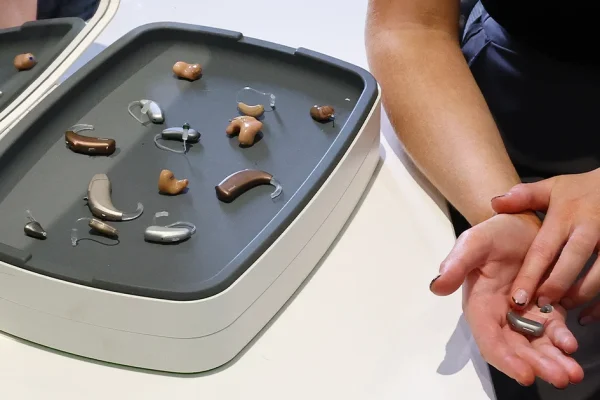
Hearing technology and hearing aids have changed dramatically in recent years. Modern devices are smaller, clearer, smarter, and more comfortabl...